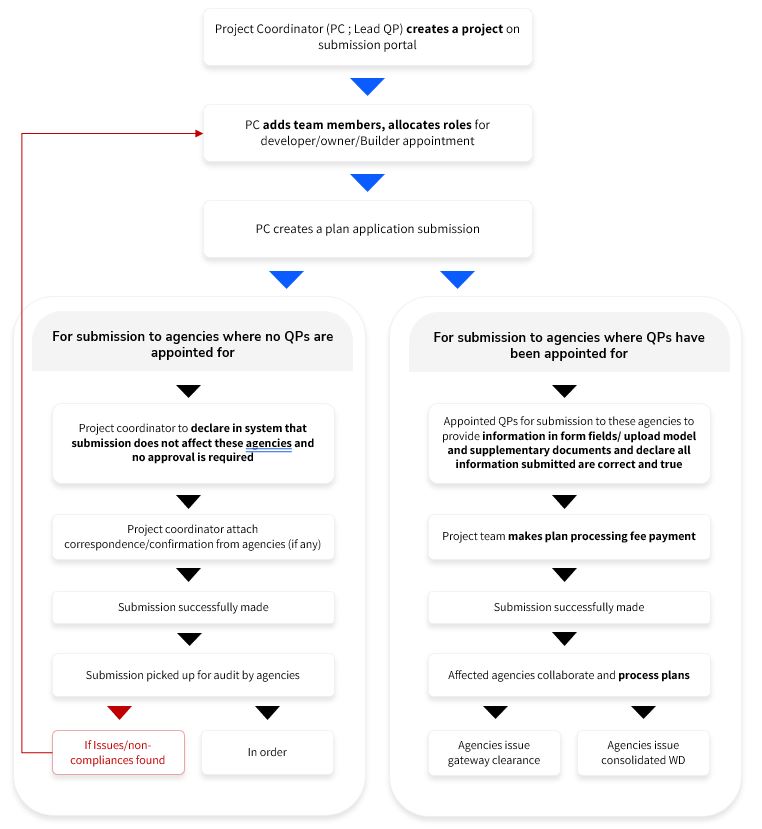
New Submission
Amendment Submission
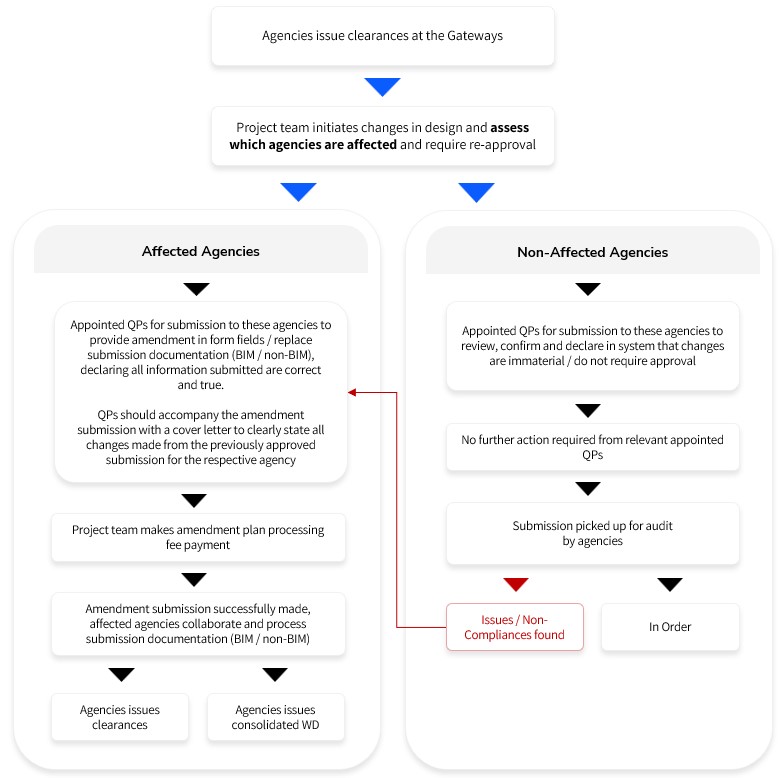
Design changes often occur during the design and construction phases. Depending on the extent of changes, amendment submissions may be required at the appropriate Gateways. Please refer to the following guide for more details on making an amendment plan submission on CORENET X.
Example of a Project Team’s Submission Workflows
- Ensure all project members have set up Singpass for Business (Corppass) settings if they are representatives from an organization, including Corppass access to the CORENET X Submission Portal (https://portal.corenet.gov.sg/)
- The project team should collaborate and agree on roles and responsibilities of respective QPs required each project
- The Project Coordinator should support / receive support to/from the project team members and assistants for smooth onboarding of all submissions.
- Within each organization, ensure relevant IT and Finance colleagues are notified of the organization’s roles in the project, to avoid unnecessary delay to the rest of the project team during submission preparations.
Useful References
- All project team members should plan carefully on the types of submissions the project will undergo, and the timing, party / parties and format(s) involved in each submission
- There are Pre-Submissions (e.g. NParks EMMP, NEA NIA) that are to be submitted by email and not via CORENET X Submission Portal – read the Code of Practice carefully for more info.
- Projects requiring JTC Land Consent can apply via CORENET X.
- Projects are encouraged to carry out pre-consultations for household / storey / transit shelter compliance
- Project team members are encouraged to carry out pre-submission consultations as early as possible, to clarify or enquire on agency requirements, potential deviations.
- Do not forget to indicate your query in the CORENET X pre-consultation submission form. The more details and information you attach in the query, the more agencies can assist and expedite your query.
- The project team should discuss the timing of demolition works in relation to when the regulatory submissions are expected to be made via CORENET X, whether through the 3-Gateway Process or Direct Submission Process
- If the intention is to carry out demolition works prior to making any regulatory submissions for new developments, the demolition submission will be a joint submission made to both BCA and URA, with the payment of applicable fees. Do note that BCA will approve the demolition submission only where URA similarly approves such demolition, or has authorised/approved the redevelopment of the site
- It is optional to submit in 3D
- If you are unable to find a particular agency’s form for your Design Gateway or Direct Submission Process, review the respective QP’s roles and responsibilities, and initiate Developer’s appointment for missing scopes to open the missing form.
- After you have indicated project information in the form inputs, the Submission Portal will show whether you can submit for Lodgement.
- Utilise the “Fee Computation” feature to double-check that Submission Portal inputs for submission requiring fee payments are correctly filled in
- Fees below $10,000 are encouraged to be paid via credit card
- There is no 72-hour deadline for payment of fees after submission. However, processing will only commence after relevant fee payments have been completed by the project team and verified by relevant agencies.
- Remember to indicate and check the last I/C and minimum platform levels in the Design Gateway IFC+SG models have been indicated and are accurate, double-checking that the levels are the same as indicated in the Submission Portal form
- Where applicable, project teams are encouraged to upload models early to utilize the “Preview Model” feature on the Submission Portal, to ensure models are geo-referenced and coordinated accurately prior to submission.
- It is not necessary to indicate “Magenta”, “Cyan” and “Yellow” colours to reflect “New”, “Existing”, and “Removed” elements in BIM models for A&A or Conservation projects. Instead, relevant IFC+SG parameters (e.g. Status parameter) should be populated for relevant elements accordingly.
- It is possible for larger projects (e.g. MRT Stations) to submit for both Design Gateway and DSP concurrently (e.g. Design Gateway for the Station Box and DSP for the Pedestrian Overhead Bridge)
- It is possible to submit for Demolition after the 1st Design Gateway or DSP Submission. Approval will only be granted after URA Lodgement or approval has been obtained.
- (Does not apply to Direct Submission Process) It is possible to submit for advance comments on structural submissions for Piling Gateway after the 1st Design Gateway Submission. Approval will only be granted after Design Gateway Approval has been obtained.
Good Practices
- Relevant agencies will provide Written Directions or Approvals after a Service Level Agreement of up to a maximum of 20 working days.
- For joint submissions, only agencies with WDs will issue responses – agencies who are ready to issue approval will not respond until the subsequent resubmission where all relevant agencies are agreeable to approve
- Written Directions for BIM submissions will also include a BIM Collaboration Format (BCF) zip files. Free BCF plugins and apps are available to view the BCF files in native BIM software.
- Do not upload outdated documents (including models and plans) into the resubmissions
- Fee top-ups (e.g. after wrong form inputs or change from lodgement to processed submission) can be made during re-submissions. Agencies may also ask for fee top-ups before issuing a decision
- Joint Submission approvals consist of individual approval/clearance letters of relevant agency line departments.
- When a submission is ready for approval, agencies will generate digital checksums for approved documents requiring agency authentication (as a more secure replacement for agency watermarks)
- It is possible to make amendments for all approvals except Design Gateway. Immaterial changes to Design Gateway approved submissions may be submitted in the Construction Gateway. When in doubt, the project team should clarify with the relevant agency / agencies.
- Major changes to the Design Gateway approved submission will require a re-submission to the Design Gateway.
Good Practices
- The Piling Gateway is an optional gateway for projects who require piling works to start earlier onsite prior to Construction Gateway submission
- It is possible to submit Piling Gateway and Construction Gateway concurrently.
- Piling Gateway submissions comprise of BCA (ST), and may be a joint submission with LTA (Rail) if applicable
- The project team, including the builder where applicable, should discuss early on how part-ST submissions should be carried out prior to pre-consultation with BCA
- Ensure the Accredited Checker (AC), PE (Geo), AC (Geo) are onboarded, appointed and aware of their roles in the projects, where applicable.
- Resident Engineers (REs) and Resident Technical Officers (RTOs) can be directly added by the C&S Engineer on the Submission Portal. The Project Coordinator and Developer do not need to get involved in their additions.
Good Practices
- Independent Submissions are technical submissions to one agency line department without affecting other agencies (e.g. ERSS works, Fire Protection/Mechanical Ventilation Plans)
- Waivers can be applied on the CORENET X Submission Portal.
- Independent Submissions can be submitted in the non-BIM format
- It is important to understand when and which Independent Submissions can be submitted for your project. Pls study the Code of Practice carefully, and clarify with agencies early if in doubt. Wrong assumptions of Independent Submissions and Waivers may lead to delays in the project timeline.
- Preparations for Construction Gateway should start as early as possible, due to the number of regulatory departments involved.
- The project team, including the builder where applicable, should discuss early on how part-ST submissions should be carried out prior to preconsultation with BCA
- Regardless of part-ST submissions, the first Construction Gateway submission must include full Architectural and M&E submission models, as well as the full C&S model "carcass" (geometrically accurate model without embedded IFC+SG data)
- Besides Construction Gateway requirements as stated in the Code of Practice, project teams must remember to incorporate Design Gateway Approval instructions and notes related to Construction Gateway submissions.
- External Works should be submitted together with the first Construction Gateway Submission
The Completion Gateway covers the regulatory approvals required before the development could be occupied or obtained statutory completion. This consists of:
- Technical clearances from relevant agencies
- Overall TOP/CSC from BCA
1) Technical Clearances from Relevant Agencies
The project's Qualified Person (QP), appointed by the developer, is to obtain technical clearances from relevant agencies based on the project's requirements. Depending on agencies' requirements, site inspection(s) or documentations such as Certification of Supervision may be required before the respective technical clearance may be issued.
📋 Documentation Required
To facilitate the process, the Submission Portal tracks the required documents from the various project parties. Project team can make use of the dashboard to track the progress.
📝 Application for Technical Clearances
Technical clearances to the various agencies can be made concurrently. These agencies include:
✓ Building and Construction Authority (BCA) – TOP/CSC (technical clearance)
✓ Land Transport Authority (LTA) - CSC
✓ National Parks Board (NParks) - CSC
✓ National Environment Agency (NEA) – TOP/CSC
✓ Public Utilities Board (PUB) – TOP/CSC
✓ Singapore Civil Defence Force (SCDF) – TFP/FSC
✓ Urban Redevelopment Authority (URA) – TOP/CSC
Not all agencies' technical clearances may be relevant to the project depending on the building works involved. If QP(s) have made the necessary declaration at the plan submission stage indicating that approval from a particular agency is not required, then technical clearances from that agency will not be applicable.
Agencies Technical Clearance Workflow
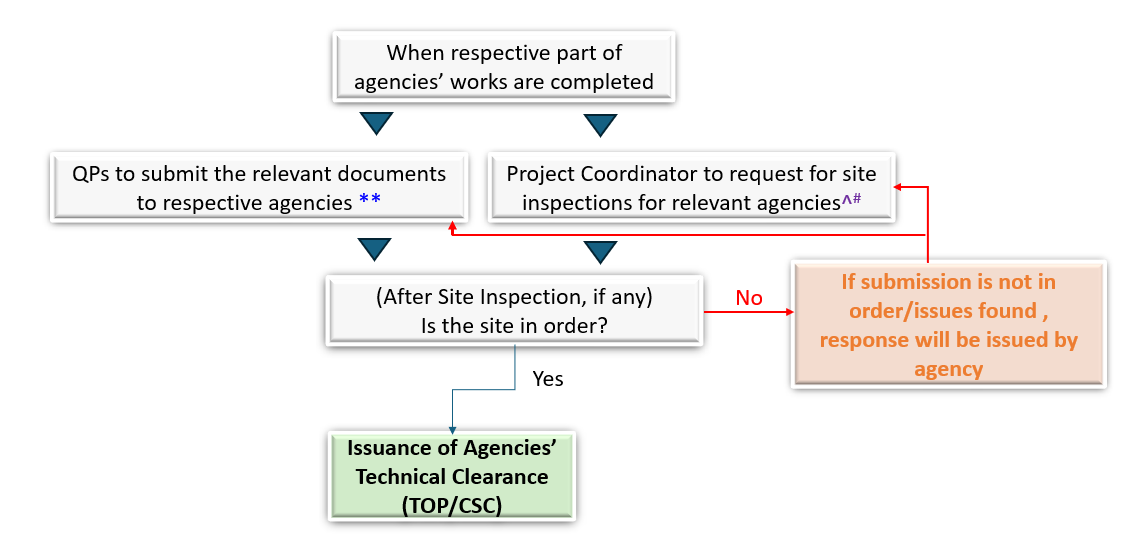
** Please refer to the CORENET X Code of Practice here for the latest list of submission documents to ensure compliance with agencies requirements. The applicable Technical clearances from relevant agencies will be based on the declarations submitted by QP(s) during the plan submission stage.
^ Site inspections conducted by BCA to be applied through CORENET X Submission Portal. For other agencies, to request for site inspection as per current practice.
# If site non-compliance is minor, agencies may request for photographic evidence as documentation in lieu of re-inspection.
2) Overall TOP/CSC from BCA
Once all relevant technical clearances are obtained, appointed Project Coordinator to apply for the overall TOP/CSC to BCA.
For the detailed workflow of each step, please refer to the flowchart below.
Overall TOP/CSC Application Process to BCA
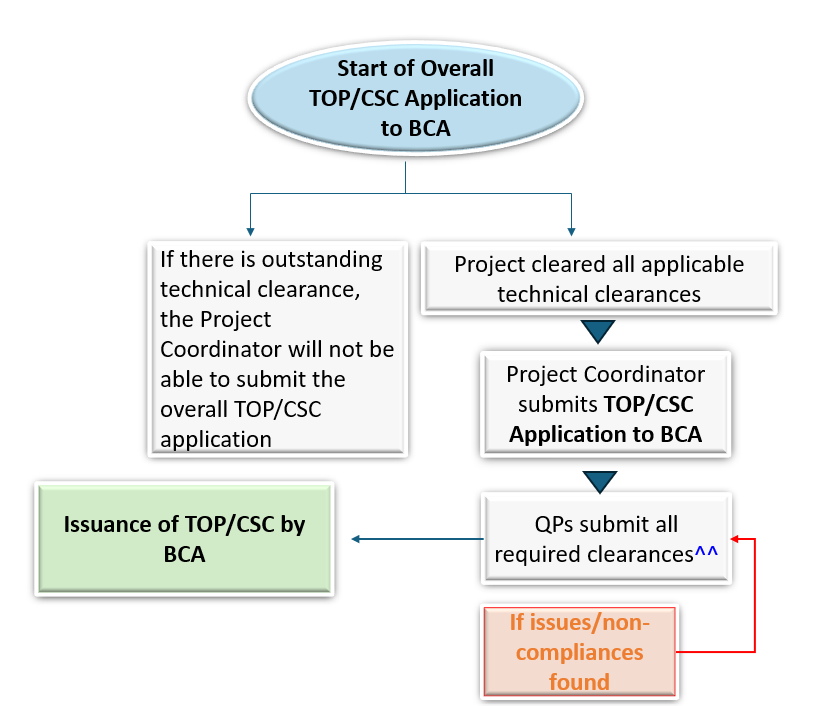
^^ As the technical departments have not yet onboarded CORENET X, QPs to submit documents as attachments per current practice for the following type of clearances:
- Fibre Certification
- SP Services
- Sentosa
- LTA (Electric Vehicle Charging)
- DSTA / CAAS
- ISD Security Screening
Overall TOP/CSC Service Standard for BCA
- TOP applications to BCA will be processed within 7 working days upon submission of complete documents.
- Express TOP applications (if accepted by BCA) will be processed within 1 working day upon submission of complete documents and receipt of payment.
- CSC applications to BCA will be processed within 7 working days upon submission of complete documents. If the application requires more extensive evaluation (e.g. due to a high number of unresolved defects), longer processing time will be required.
Partial TOP Applications
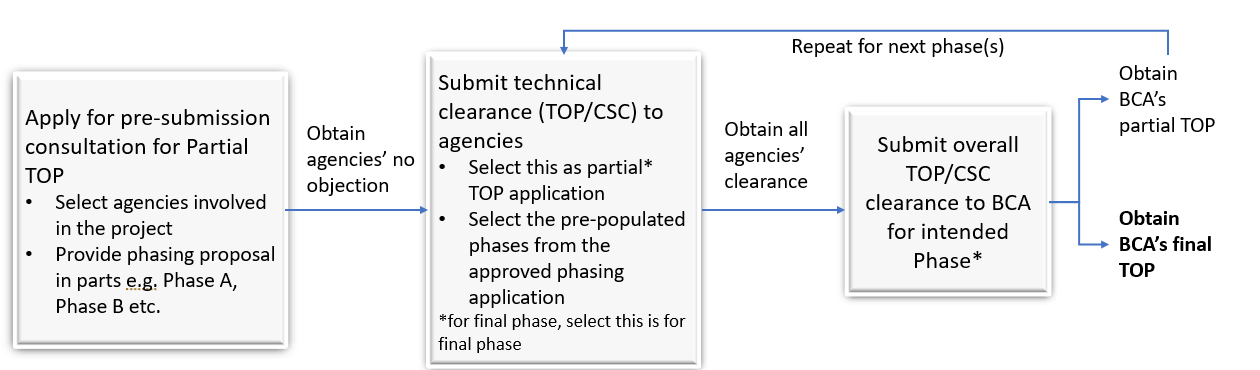
- Project Teams to propose a partial TOP phasing plan and seek agencies' concurrence at the pre-submission consultation module before making submissions
- Check project's eligibility for partial TOP before proceeding with pre-submission consultation
- Select any or all applicable agencies for the pre-submission consultation based on the project requirements
- Add scope for each proposed partial TOP phase in the pre-submission consultation
- Include TOP phasing plan as part of the pre-submission consultation documents
- Any changes to the approved TOP phasing scope from the pre-submission consultation will require a new submission to seek approval from all relevant agencies
Partial TOP Applications
Good Practices
- ✓ The Completion Gateway consists of a one-stop dashboard of the project's status of TOP/CSC applications across various agencies shown on the CORENET X Submission Portal which can be used to guide project team
- ✓ If IFC models had been submitted earlier in CORENET X for the project, as-built submissions should consist of latest updated IFC models, with IFC+SG data updated upon the earlier approved models to respective agencies.
- ✓ Verify the 2D and 3D documentation required for the Completion Gateway, especially if they are created by parties onboarded later in the project
Introduction of Checksums for Approved Plans
A checksum is an alphanumeric value that uniquely represents the contents of a file. It is akin to the digital fingerprint of the file.
In the approval response, the QP will find a “List of Approved Plans” by each agency. The QR representation of the Approved Plan’s checksum will be listed in the “List of Approved Plans” (1 unique checksum per file).
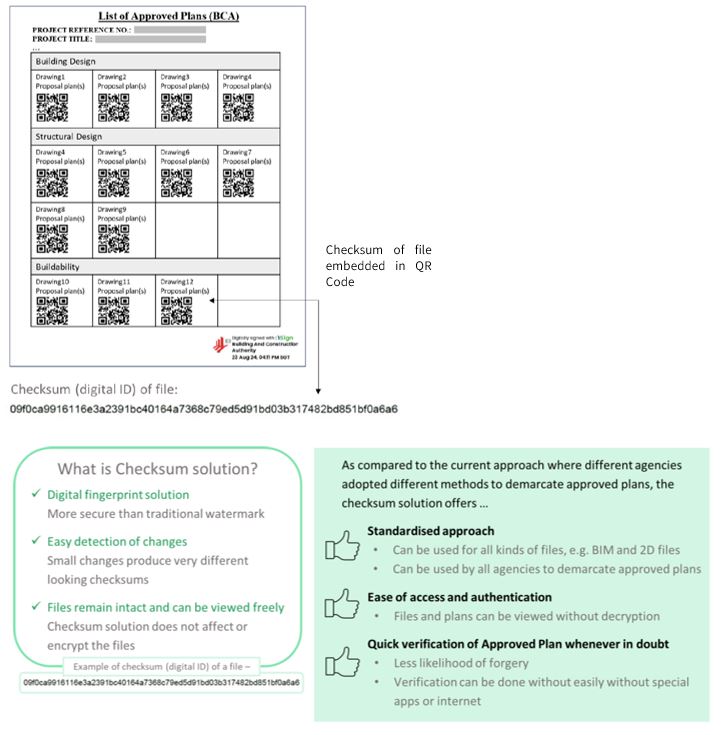
To verify if a file is the Approved Plan, you can compare the checksum of the file with the checksum listed on the “List of Approved Plans”.
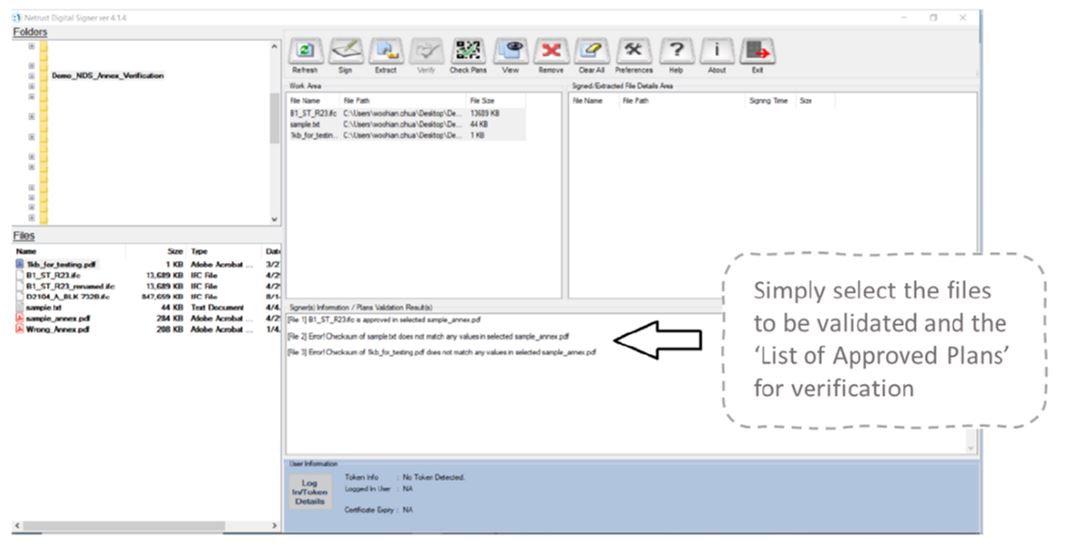
Verification with Netrust Digital Signer (NDS) [coming soon]
Verification without Netrust Digital Signer (NDS)